Sunday, December 2, 2012

The Tale of the Tail--I Am Back In Hospital! Plus "Atom Blake, the Boy Wizard" from "Wow Comics" #2


Friedns, it hab been far too long snice last we met. I wirte these words from a hospital bed! It is dififclut to type on my laptop. But try I shall to endeavor to achieve this goal. For you, my firndrs, are dear and near to me—tho’ I may nvevr meet you in person, we are brothers of the art panelologic!

I have been in room 343 of the Emberton Memroial Mecidal Center for two weeks now. And, no, dear reader, ‘twas not a bout of the gout, as they might quip. ‘Tis a most exotic ailment that afflicts me! I have a broken coccyx! You may well call this “The Tale of THe Tail!”

‘Twas a pleasant night in Novebmer… the air was mild and csirp, with the woodsy smell of the autumn season. Typically, Raphael mops the Diner on Thusrday nights. He has always done it—nveer having been asked, never having apparently voltuneered for the task. He does artful work with a mop, bucket and his “mezcla de mezcla especial”—in relatiy a blend of Comet, Clorox, Pine-Sol and parsley flakes. 

There—I have managed to ring for a nurse, and get this bed-table adjusted! What a difference this makes1 Now I shall try to be a more mindful tpyist. 

On this fateful Thursday, Raphael had to leave immediately upon closing—he referred, throughout the day, to a “special errand” and, to be sure, seemed pre-occupied. His heart was apparently not in his usually zestful role of maître d’ for Dorrie’s Diner. He merely waved in new visitors, as would a grade school crossing guard, and let them meander to any apparently open spot.

Among one such group were a party of toddlers, from a nearby daycare center. A pair of harried, frazzled young adults accompanied them. There was much talk of “an ice-cream treat,” the mere mentoin of which whipped this wee group into a frenzy.

One child had a mesh sack filled with those “Hot Wheel” cars that have been so polupar for so many years. His sole focus was on these tiny stylized autos. An endless array of motor sounds—all quite convincing—issued forth from his young lungs. Several times, I cringed in anticipation of the sudden impact of a truck into the vulnerable North Wing of the Diner, which faces a very busy, frantic State Road.

Much ice cream was messily consumed, and the sated babes bobbled out the door. The dnier suddenly seemed quiet—as they say in old war movies, “a little too quiet.”

Shortly thereafter, patrons complained of “that sticky floor.” One surprised elder gentleman tapped me on the shoulder several times, to get my attention, then told me. “Almost lost my shoe. Something should be done, sir. Something should be done!”

As foot-traffic commenced, during the dinner hour, the floor became more of a hazard. Thursday nights the Diner tupically entertains a group of Whist players. They bring their own cards, a great deal of boisterous good spirit, and several bags of pistachio nuts, still in their sturdy shells. 

Their card games are “fast and furious,” and tend to shoo other customers out. Fortnately, these Whist-ers have big appetites, mostly for desserts, and tend to run up a sizable bill at night’s end. They kept Raphael “hopping” with constant requests for coffee refills, crème brulee re-orders, and such.

The slapping of the cards, the crackling of nut shells, and the constant murmur of their voices has become a Diner ritual on Thursdays. I was, truth told, anxious for the day to end.  I had a “four day weekend” commencing on that Friday, and was eager to spend some “quality time” at the “New Pantheon,” the better to reconnect with you kind friends and share some four-color jewels from the “vault.”

In such a mood, I tend to daydream, and disconnect from the humdrum world around me. I was lost in a reverie of my discovery of a significant new Fox Features title, Hi-Tension Comics (which, alas, does not exist). Such “visions” are fairly common to me, and inevitably result in confusion and disappointment, as I rifle through my archives in the “Pantheon” only to realize the title I seek is not in this plane of reality.

You see, I have my spiritual side, too! Are we not all complex beings?

Finally, the Whist fest came to an end. The bill was paid, and the entourage of “gamers” went to their abodes to dream of another Thursday. Upon their departure, I discovered a startling admixture of expended nut shells and the crispy, brittle candy-like toppings of crème burlee in small mounds on the floor.

Coffee and whipped cream spills aggravated this catastrophe. On top of the down-trodden, adhesive remnants of the ice-cream, from earlier that day, the floor was a disaster area.

As I pondered this dire situation, Raphael bid me a cheerful goodnight. He was dressed in a 1940s style pin-stripe suit, complete with fedora. In one hand he carried a Whitman’s Sampler. In the other, a well-worn suitcase. “See you soon amigo!” he cried with delight as he “hit the road.”

The accountancy of the day’s “take” was a consumptive nightmare that even I, the seasoned CPA, could barely fathom. One hour of intense “number crunching” and the receipts were tallied, and the books balanced. At last I could retire for the day!

Then I realized the floor must be attended to!

With a deep sigh, I plodded into the back storeroom. I wheeled out the mop bucket, and fashioned my own blend of Comet, Clorox and Pine-Sol. I could not find a container of parsley flakes, so I substituted some ground nutmeg.

Before the mopping proper could commence, I had to sweep, chisel and otherwise bodily remove the more three-dimensonal aspects of the floor’s contents. My friends, those pistachio shells were almost ankle-high under the table! I had to use a metal dustpan to chip away at the brulee accumulation. I must have swept up 100,000 expended nut shells that night… which stressed my lower back critically, preparing me for my incumbent calamity.

Having removed the worst of the debris, the mopping wsa a mere formality. It took several “passes” to render the floor walkable and clean. The pungent blend of cleaning products tore at my nostrils. Sweat beaded on my weary brow. And then, finally, the dire task was done!

Oh, how weary I was. I am no spring chicken! My lower back creaked as I stood up. I wheeled the mop bucket to the darkest recesses of the backroom, and left it for Katrice to empty. (She will empty any open container of liquid she encounters, as I have discovered when lifting a once-full mug of coffee to my lips, only to find its contents gone.)

I wiped my brow, gathered myself together, and doused the Diner’s lights. The deposit could wait ‘til the morning!

Then, as I approached the door, my right foot met with one of those accursed “How Wheels” cars. Zip! I left the ground. I scrambled to regain control of my footing. Then my left foot encountered a pistachio nut, forgotten from the Whist players! Zoom! Again I lunged, my right foot once again connecting with the “Hot Wheels” toy. Down went McGinty—er, Moray! 

I fell with a thud on my tail-bone. The impact loosened a flock of laminated Diner menus. These rained upon my head in a dull shower.

Oddly, I felt no pain. Rather, a curious relief washed over me. I was off my feet. I stared up at the darkened ceiling, and then thought it best to close my eyes, to regain my composure for the trip home…

“Hey, fella,” a coarse voice said. Something hard tapped at my shoe. “Let’s see some ID, fella.”

I had dozed! I woke with anxiety, and saw a policeman hovering above me. “Wh-where am I…”

“Better come with me and sleep it off, fella…”

“I beg your pardon! I am the owner—rather, co-owner—of this establishment. If you’ll permit me to rise to my feet…”

And then, dear reader, my heartache (or backache!) began. As Officer Rutledge, the fellow who tapped my shoe and roused me, later informed me, I fainted as I attempted to stand tall. An ambulance was called, and I rushed to Emberton Memorial.

I was informed that I had broken an un-needed bone—that of the coccyx, or the “tail bone.” Like the appendix, there is not need for it in our daily lives, and yet it has persisted throughout time in our bodies. Curious thing, science!

The doctor said that I would be bed-ridden for at least a fortnight. My legs were slightly elevated, to reduce pressure to the broken coccyx, and a special pillow (which was changed five times a day) further cushioned the bruised bone, the better to speed its healing. My lower back was encased in a curious lattice-work of plaster, medical tape and some type of medical plastic.

Needless to say, I was to enjoy a much longer holiday than anticipated!

My first visitor was my compadre in things panelological, “Sparks” Spinkle. He looked woebegone. “Back in the saddle again, eh, Mace?” he said with a weak grin.

“I’m not dying, I assure you. Wipe that sad look off your face,” I said with good cheer. “I may be trussed up like a Thanksgiving turkey, but I’m in good spirits overall.”

We talked, just chit-chat between friends, and in the course of our meanderings I mentioned my desire to spend some serious time at the “New Pantheon,” studying the art of panelology and perhaps making some notes towards my forthcoming encyclopedic history of the Golden Age of the American comic magazine. (But more on that later.)

“Uh huh,” “Sparks” repeated, nodding gravely. “Mm hm.” He held  his chin in his hand, deep in thought. 

“Mace, where are your keys?”

“Wherever my personal belonging are. I awoke in this room. I assume they were taken care of…”

As I spoke, “Sparks” opened drawers and cabinets. I finally heard a muffled “A-ha!” and a muted jingle. 
Then, a clunk as he dropped the keys. Then another jingle, another clunk, and some soft cursing. “Slippery fellas!”

“Sparks” looked sheepish. “Long story short. You tell me what comics you wanna study; me an’ Raphael will go an’ get ‘em an’ bring ‘em here for ya!”

“Oh, you don’t have to do that…”

“I… in… SIST!” was my friend’s fervent reply.

Once “Sparks” has an idea in his head, there is no stoppage of it. One might better hope to contain a tsunami in a paper cup. Calmly, I explained that this room had limited space, and that much leeway must be given for the various doctors, aides and nurses to do their important work. Thus, I limited him to one long-box. 

At random, I chose R-11. I could not recall its contents precisely, so it would be a delight to peruse its 100 bagged and boarded treasures.

“Better write that one down, Mace…”

“I have no pen or pencil. R-11. Just remember that. R-11.”

“R-11… R-11…” “Sparks” wandered out of the room. “Be back soon,” he said in the hallway.

As I am wont to do when in bed, I dozed off. How deep my sleep was, I cannot fathom. A familiar scent roused me from the arms of Morpheus. So rich, so pungent, such a warm and woodsy aroma…

Vintage pulp paper! Like a child on Christmas morn, I opened my eyes…

The room was filling to capacity with choice gems from my archives. Several long-boxes dominated the room, plus armfuls of loose issues, all protected by their museum-quality bags and boards.

“Forgot what box you wanted, Mace, so we brought ya a whole bunch. Take your pick.”

“Si, Senor Mason, Haga su elección!” Raphael grinned from behind a stack of vintage treasures. A few of them slipped off the pile and scuddered towards the floor. I grimaced as would a man in pain.

“Gentlemen, I asked for one long box. That is all this room will accommodate.”

“Sorry, Mace, I kinda got carried away.” A male nurse entered the room, assessed the labyrinth of panelology, and became instantly indignant. “What’s all this s***?” he cried.

“It shall be cleared out, sir, it shall be cleared out.” To “Sparks” and Raphael, I quietly, kindly stated: “Leave one long box. Please return everything else to the Pantheon. I thank you for your kind effort.”

“Aw…” “Sparks” looked deflated. “Well, which box, Mace? It’s your shootin’ match.”

“Any box will do. I am not particular. That one there,” I said, pointing to a longbox situated within arm’s reach of my bed.

“Hokey dokey,” “Sparks” said with great reluctance. “But don’t come cryin’ to me when you get bored…”

Ay, que lastima,” Raphael sighed under his breath. He regathered the loose stack of magazines and left the room.

I heard a myriad of plop-plop-plop sounds in the hallway. Following them was the skid and clank of medical equipment. Voices of confusion filled the corridor. Finally, a sheepish “Sparks” re-entered my room. “We got a casualty, Mace.” He held up a mangled issue of Jughead, circa 1953. “She’s still intact, just a little… dented.”

“No great loss,” I assured him.

The remainder of my treasures were carefully removed from the room. I cannot assess the safety of their journey back to the vault. I am, understandably, somewhat anxious to be well again, so that I may assure myself they did not suffer the fate of that lone Jughead.

It took my friends three trips to successfully remove the excess magazines. It occured to me that my scanner might prove a helpful tool while I rested in thsi room. Thus, before their third trip, I diligently requested that my scanning device (and power cords) be brought to my room. Fortunately, the alert Raphael "grakked" my request and assured me all components would be imported to my bedside.

Thus, I am able to share a seldom-seen treasure from a most unlikely source.

I am not an enthusiast of the Fawcett comic magazines. Their assembly-line production, to my eyes, renders them lifeless and moot. But in the earliest issues of their various flagship titles, some brave souls dared to buck the system and produce tales of fantasy on their own.

Such a rare gem is Russell G. Gorson's "Atom Blake, the Boy Wizard." seldom have such complex motifs of science fiction been so lovingly presented within borders and balloons. Please take time to read this story. I will, of course, have some "commentary" on this unique tale.


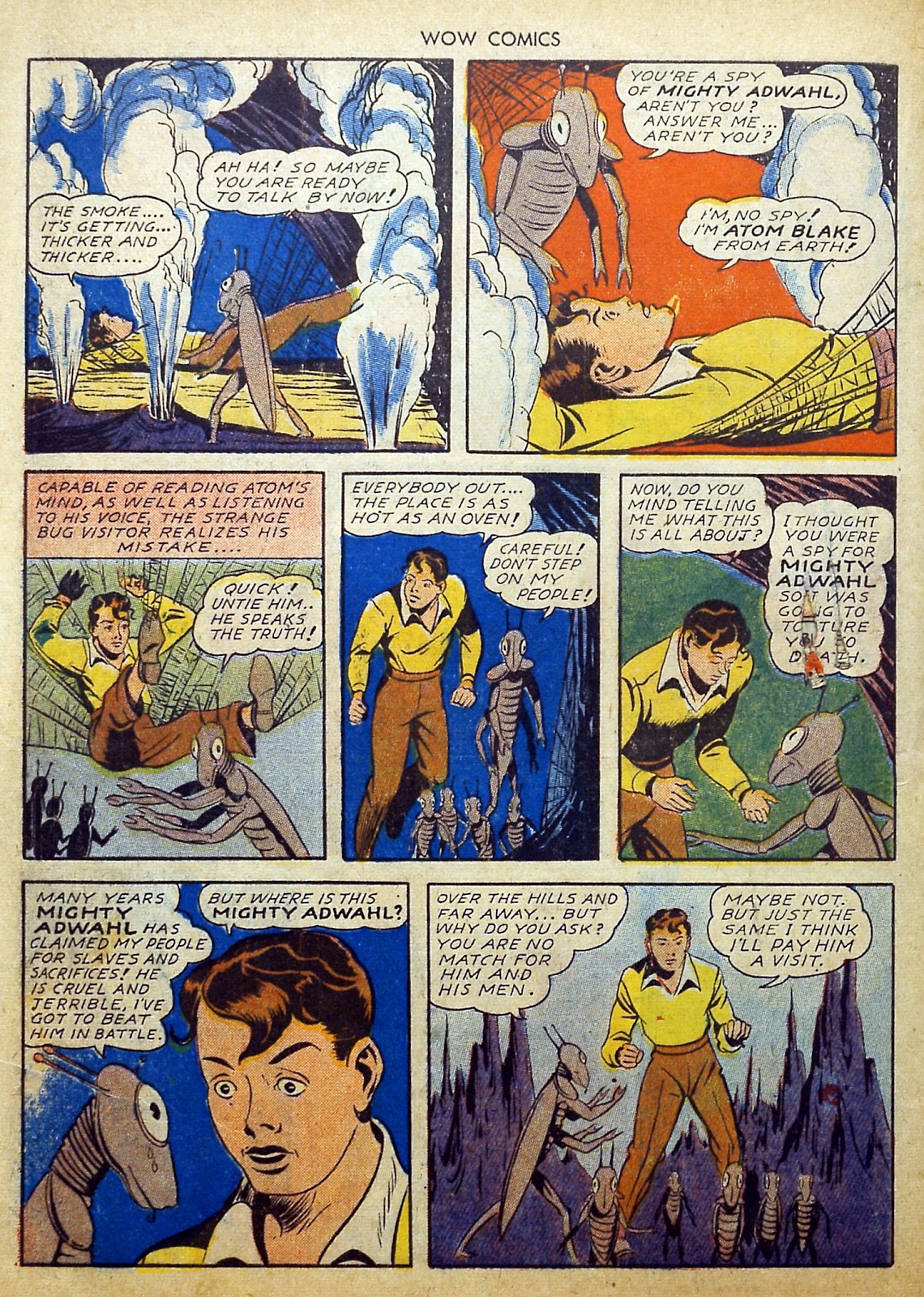


What, upon first reading, seems merely a knockabout boy's adventure, is, in fact, a deeply felt, deeply encoded parable of the suffering of the Albanian peoples during the first World War. Russell G. Gorson was the pen-name of Fisnik Gazmend, a refugee from that forbidding regoin. 

During the first War, many Albanians were imprisoned by the Kaiser's army, and forced to abandon their homes and careers to perform manual labor. Young Gazmend and his family, former stock-brokers of considerable wealth, were stripped of their status and clothes and put to work as miners. 

The subterranean caves in which they worked are remarkably realized as the wastes of the planet Mercury in this story. To a child of wealth, suddenly removed from his home and given a pick-ax, Hessians barking foreign commands to him, he might as well have been on Mercury!

Gazmend was separated from his parents, whom he assumed he might never see again. This trauma resonates through all his panelological work. It is, one might say, his central theme. Gazmend escaped Albania, was rescued by British troops, and eventually obtained passage on a boat to America. 

Once in our country, Gazmend began to realize his destiny as a comic book creator. Of course, he would have to wait until the late 1930s to ply his craft. In the meantime, he found work as a sign-painter, a roofer, a trainer of gazelles and as a math teacher.

Like many refugees of Europe, he sensed the threat of the Second World War, and was compelled to warn young readers of the fate he suffered. His serious autobiographical accounts were shunned by New York publishers. Gazmend was seriously "ahead of the curve ball" in this regard.

Harry Hornfeld, an assistant editor at Fawcett, liked Gazmend's work, knew of his back story, and wanted to help. "Change them Krauts to monsters, an' you'll have somethin' we can publish" was his sage advice.

Gazmend redrew a portion of his 650-page autobiographical story, Jeta ime i mjerimit të pafund ("My Life Of Unending Misery") as the first installment of "Atom Blake." It was immediately accepted for a new Fawcett title, Wow Comics. Later installments held less of his life's story, and more of stock fantasy elements.

Gazmend patiently waited out the war, and in 1947 he was able to return to his homeland. Remarkably, his parents were still alive and in good health. Jeta ime i mjerimit të pafund was still in Gazmend's possession, but it found no publishers. Its images held too many sitll-raw memories for the Albanian peoples.

Sadly, this early masterpiece of autobiographical comic book work seems to be lost. Perhaps it shall surface someday in an Albanian attic. It is not known what became of Gazmend upon his return to the homeland. One hopes--dearly--that he had a happy life, even though under the iron fist of Communist rule.

***

You will recall that, earlier in this missive, I dropped something of a "bomb shell." Yes, friends, I am at work on a 1000-page definitive critical overview and history of the Golden Era of The Art Panelologic: 1937-1942. (That is, indeed, the working title of this tome.) This book shall be my legacy, as it will contan the fruits of my many years of research and insight. I hope it shall be finished in the next few months. 

I am eager to be released from the hospital so that I might begin work on this volume in earnest. The constant beeps, clicks and hisses of this room are mightily distracting.

If Dcotor Milligan's estimate is correct, I should be home in time for Christmas. I hope to end the year with a rousing Yuletide treat, as has become a tradition of kind on this bolg. Until then, rest well, friends, and watch your coccyx!


Thursday, June 7, 2012

Travels Galore--plus "The Eye," by two different artists, from the same issue of Detective Eye comics, 1940

Salutations, friends, neighbors and countrymen! I have returned from an extensive tour of our fine continent—almost from sea to sea!

‘Twas a taxing odyssey, at times, but scarcely was it less than rewariding. My first voyage you read of last time on this blog. My father and I took a “road trip,” the better to spend some “quality” time as “father and son” together. Dad, though of advanced years and diminished hearing, is as robust as ever. And, friends, he requires no amplification. Seldom has a human being been gifted with such a resounding thorax, such a majestic sound-box, as dear old “Dad.”

Dorrie wisely insisted I purchase some “Noize-Off” industrial-strength ear plugs. This was perhaps the best buy I’ve made since my bargain win of the rare Our Flag Comics #1 on eBay. I seldom brag, but I must “toot my honr” here… I won said purchase for a mere 19.43! the other Bidders were clearly “sleeping at the wheel” on that day.

But I digress. These flesh-colored ear devices were alleged, on the plastic sack in which they are sold, to “slaughter unwanted noize!” I suppose there is some significant distinction between “noise” with an s and “noize” with a z. Regardless, the plugs helped tone down the volume on “Pops” to a level of normal, courteous conversation. The down side—and is there not always one, friends?—was that they also greatly reduced other sounds, such as the horns and screeching brakes of oncoming motorists.

It took such intense concentration to focus on my father’s now-muffled voice that I seldom heard the “tells” of my fellow travelers. We wound up in a ditch, to my everlasting chagrin, outside of Wheeling, West Virginia. The “Prius” was wedged at about a 60 degree angle for a little over an hour, as the AAA service was exceptionally slow to respond to my distress call. (Thank heavens I had charged the cellular phone sufficiently!)

Why, you may ask, were we outside of Wheeling, West Virginia? Dear old “dad” wished to travel down “memory lane” on our s pecial father-son voyage. As he put it:

“BE NICE TO SEE SOME OF MY OLD STOMPING GROUNDS ONE MORE TIME! YOU KNOW, MACE, I’M NOT EXACTLY A SPRING CHICKEN ANY MORE! NO, SIR. GETTING ON IN YEARS!”

 I’d had “Pop” prepare a “top ten” list of places from his past he most wished to see. (With the stipulation that these spots remain close to the Eastern seaboard, and be no more than two days’ drive inland.) I scanned in his list, and share it with you now:

Seven of his choices no longer existed. Honey’s Bowling Den was shuttered in 1981. In its place was a small correctional facility! “Dad” chuckled at the inherent irony. “BET THEY JUST PUT BARS ON THE WINDOWS AND PAINTED THE THING GRAY,” he commented. “THERE WAS SOME SHADY TYPES USED TO POP IN THAT PLACE.”

I suggested the site of the IBM plant, where he spent a significant chunk of his working career, but he demurred. “SEEN ENOUGH OF THAT SPOT TO LAST ME A WHILE. STILL REMEMBER THE TREES AND SHRUBS. THE CANDY MACHINE ON THE FOURTH FLOOR. NOPE, SEEN ENOUGH OF THAT SPOT, SON!”

“1767 Fletcher Lane” was still standing, and brought back a flash of forgotten memory. This was the house where I was born! We lived there until I was five, and I only recognized it from its appearance as a backdrop to some home movies and blurry snapshots of that era. “SHE’S STILL STANDING PROUD,” my “pater” commented. “WONDER IF THE CRAPPER STILL HISSES FOR AN HOUR AFTER YOU FLUSH ‘ER?”

I wittily suggested that perhaps we might stop to check. “SAY, THAT’S A GOOD IDEA, MACE!” my father said. 20 minutes of curbside debate ensued; I on the “don’t knock on the door and ask to visit the restroom” side, and he holding the “WHAT THE HECK? CAN’T HURT TO ASK” position.

You might guess which side won out. The elderly widow was perhaps startled to see these two road-weary figures at her door. My father introduced himself as “A FELLA WHO USED TO LIVE HERE, ROUND ABOUT 1950, ’51.” The woman kindly invited us in. For all she knew, we might have been escaped lunatics, or encyclopedia salesmen!

“JUST GONNA VISIT THE HEAD FOR A SEC,” my father said. The woman held her hands over her ears and winced at my father’s volume. She asked me to sit with her in the living room. After a minute, a great flush issued from the rest room, followed by a minute of metallic jiggling. An audible, rumbling hiss echoed from the back hall. Shortly, my father returned, and joined us in the living room.

“YEP,” he finally said. “STILL GOT A TENDENCY TO RUN FOR A SPELL. YOU MIGHT WANT TO GET THAT LOOKED AT SOMETIME.”

The woman uncovered her ears. She appeared a bit disoriented. “Y-yes, I reckon I will…”

I explained (in a normal tone of voice) the nature of our trip, and that this was my first home. She brightened considerably. “Well then, you shall have lunch here, just as you once did.” Despite my polite protestations, she went into the kitchen. She returned shortly with a pile of olive loaf and pimento loaf sandwiches, spread with Durkee’s Special Sauce, and a pot of weak but welcome coffee.

As we dined, I attempted to control the conversation, the better to spare our elderly host’s ear drums. But “dad” had many questions. “HANK LEVINE STILL LIVE NEXT DOOR?... DOES THAT PAPER BOY STILL THROW THE DURNED SUNDAY PAPER ON THE ROOF?...CAN YOU STILL HEAR BERT JENKINS SNORE?”—and so on. All these people were, of course, long gone, and the questions simply bewildered the poor woman.

Finally, she cleared her throat. “W-well, I’ve got my shows to watch.” She interlaced her fingers, as if to pray, and smiled weakly but hopefully at us.

“THINK SHE WANTS US TO VAMOOSE,” my father said.

On that ear-splitting note, we exited my first abode, and returned to the road.

‘Twas good that only three of these places still existed. Elsewise, our week-long foray might have lasted a month. I was scheduled to travel to the Pacific Northwest with Dorrie, to attend a series of independent restaurateur seminars in Portland, Oregon, Seattle, Washington and Boise, Idaho. I attended solely out of spousal support. Those endless talks invited Morpheus mightily! Alas, the insistent elbowings of my "lady" assured that my eyes would remain open throughout these calcifying "seminars."

While in Seattle, I responded to an invitation sent months ago by John Gill, who is a fellow “blogger” with a site called “The Trick Coin.” I saw nothing about numismatics anywhere on his “blog,” but it is nonetheless worth a visit or two. (I hope this "linker" will work for you! If not, please let me know.)

John also creates a “pog-cast” for the Internet. Apparently it is some sort of interview program. That was the basis of his invitation.

While Dorrie attended a recipe seminar at the downtown “W” hotel, I visited Mr. Gull’s humble abode, which is surrounded by hospitals and roaring ambulances. Amidst this sonic chaos, I was interviewed for his “pog-cast.” We spoke mainly of my “blog” and of my accomplishments as a panelologist. If you have a few moments, and wish to hear me speak, please visit “The Trick Coin” where the entire program is archived.

And, when you listen, friends, worry not! None of those sirens were to do with Dorrie or the seminar, which passed quite peacefully and in a good spirit of democracy.

Dorrie returned from the seminars abuzz with new ideas for the Diner. She had a notion to christen the northeast sector as “Peking Corner,” and serve Asian cuisine there, and there only.

It is night-impossible to dissuade "the little missus" from an idea, once her mind is set. I tried to suggest that having one distant corner of our diner devoted to Asian fare might puzzle our elderly regular customers. The "sit where you want" policy we have strived to create would be shattered by this small change.

As  is, the idea is "on hold" while a possible menu is prepared. Perhaps the idea will just whisk away, as do many of "the wife"'s bolder notions. Time will tell.

I am no fan of air travel! The seats are painfully uncomfortable, and my ears are ill-prepared to withstand the pressure changes of the climate-controlled cabin. 'Tis fine to be back on terra firma, in the places I know and love.

And, of course, in the proximity of the New Pantheon, with its stockpile of treasures. On a brief visit, to check the smell of the place (pickle and chip scents gone; blueberry Febreze scent rather overwhelming) I opened an archival box, closed my eyes, and reached in. This fabulous artifact was my reward:


This fascinating publication boasts several worthy features, but 'tis a unique twist given its titular character that comprises this post. "The Eye" is among the most godlike of the early panelological creations. Indeed, there is a solemn religious aspect to the feature. The "Eye" is simply that--a floating, disembodied (and rather angry looking) ocular orb. Its mission  is the elimination of evil-doing.

Since it is an eye, and cannot operate machinery, ring doorbells, write letters, et al, "The Eye" must seek  out the aid of corporeal individuals--"ordinary Joes" such as you or I. 'Twas an eerie, unusual notion for a panelological figure.

In a fittingly peculiar twist, two different writer-artists helmed "The Eye"-- creator Frank Thomas and one Mark Schneider. There is, as usual, a fascinating (if somewhat tragic) story behind why these two men presented their differing takes on the "Eye," under the same covers of a comic magazine. I shall relate this after you absorb these two stories. The first is Schneider's; the second, Thomas'.


There are, in fact, TWO episodes of "The Eye" by Frank Thomas in this magazine. I have selected the second, and best, of these efforts:


As is immediately evident, the styles of "Mark Schneider" and Frank Thomas are significantly different. Each aspect of the panelological art--from lettering to the "spotting of blacks" (and I see many throughout both stories) could not be different.

Brace yourself--these two stories were created by the same man!

Frank Thomas, throughout his long career in comic magazines, was certainly a "workaholic." He lived to put pen and brush to illustration board, and to plot his many panelological tales, which included "cartoon critter" exploits for various Dell titles and several ventures into the costumed-hero genre.

In his waking life, Thomas was driven to succeed, although often frustrated by his limitations as a draftsman. He tried hard to imitate the realism of modern artists such as Milton Caniff and Alex Ramyond, but could only create a passable imitation. Thomas' real skill lay in creating softer, more "cartoony" characters. The hard edges of comics realism were seemingly not for him!

But at night, another personality emerged. Thomas was a chronic sleep-walker, and had been so since his childhood. So used was he to his regular noctural excursions that neither he, nor his family, friends and loved ones, gave it a second thought.

If the waking Frank Thomas was a "workaholic," his sleepy-time alter-ego was a "workamaniac," if I may coin a new word. "Mark Schneider," as this alter-ego called himself, was a more accomplished cartoonist, and a devil-may-care jack of all trades. "Schneider" would tune neighbors' cars, paint their houses, fix their roofs, build fences and chicken coops for them--and, if reports are to be believed, "Schneider" once installed a 20-foot flagpole, weighing over 200 pounds, and flying the flag of Prussia, in a distant neighbor's back yard!

When not creating home improvements, or flying a Piper Cub airplane, "Schneider" joined his waking self's love of the comics medium. As Thomas said in a 1965 interview:


I had no idea this was going on. I always woke up, you know, feeling tired. Saw the doctor many times. He couldn't come up with an answer. And the funny thing--I'd find these "Eye" stories on the front seat of my car. Had a '39 Chrysler Royal at the time. Never could tell when these things would show up. A whole story, penciled, inked and lettered! I never met this Schneider fellow. Assumed it was the editor's doings. It wasn't until I underwent hypnosis that I learned this Schneider character was me! I wish I could have collected his paychecks for these darn stories--"he" sure worked hard on 'em!

Hypnosis cured Thomas of this nocturnal double-life in 1955. From then on, Thomas religiously slept 10 hours a night, and continued his panelological career full-speed.

From that same interview, here are his thoughts on "The Eye:"

I remembered a saying my mother had. She'd tell me to always be good, because somewhere, an eye was watching me. I was inclined to be a bit of a rascal--always getting into the cookies--and this was her way to keep me in line. I used to lay up nights, scared to death of that eye. Thinking, 'I bet he's looking at me right now. I wonder what he thinks of me.'


Well, as I grew older, I forgot about this business, but I still had this feeling that something was going on while I slept. And that, of course, was this Schneider fellow, who I was at night. Boy, could that fellow draw! 


He actually came up with the concept for "The Eye." He left the first story on the seat of my Royal, wrapped in red ribbon, with the card attached that read "From A Friend." His idea was really good--and, boy, did it scare the hide off of me, when I remembered the story my mother used to tell me. I figured, 'if this scared me when I was boy, I'll bet it'll excite the children of today!' 

And I was right. "The Eye" was a big hit. I had to drop it when [Oskar] Lebeck hired me at Western. I tried to revive it for some of his titles, but it wasn't the same. And I was happier doing the bee series. Those were nice little stories for a change.

"The bee series" is Thomas' long-running "Billy and Bonnie Bee," which did indeed delight children for several years, and remains among the high points of the "cartoon critter" genre.

"Mark Schneider" illustrated some other comic magazine features before he disappeared from the panelological realm in the mid-1940s. It appears that "Schneider" wrote medical journals, pulp detective thrillers, and instruction manuals until his official hypnosis-cessation in 1955. His vanishment from comics art was a loss to the genre,

Well, this has proved an unusually long posting for me. I confess I'm tired. The couch--and a nap--beckons. I trust that I've no "Mark Schneider" to run colossal errands while I sleep! May your rest be free of highly active alter-egos as well, my friends!

Wednesday, April 25, 2012

Long Time No See: News and Anecdotes, plus "The Little Giant," from the sought-after "O.K. Comics" no. 1

Salutations, friends of the four-color art! It seems that each post I write must begin with regrets. I dearly wish I had more "free time" on my hands to attend to this "blog" of mine. I know there are friends who enjoy my postings--they are, after all, a literal history lesson in the far-flung fields of panelology.

Worry not, companions--I've not forsaken my beloved comics art! Life has intruded, as it's wont to do, and kept me away from the New Pantheon much longer than I desired.

Said New Pantheon was long overdue for an airing out. The last time I had ventured there, with garrulous "Sparks" Spinkle in tow, he had brought along a bag of thick-cut sea salt and vinegar potato chips, with a jar of garlic dill pickles for a chaser. "Sparks" is, of course, forbidden to touch the treasures of the Pantheon with such corrosive agents in his reach.

No sooner had my hunt began for potential "godies" to post on this blog than a call came--panicked--from the Diner. Katrice had set fire to the ceiling! No one knows, or will ever know, why or how she accomplished this. But our entire ceiling--from kitchen to cash register--had to be sanded and painted. Because of this, we were closed for nearly a week.

As a lession to Katrice, she was docked three hours' pay for this mischief. It is so very difficult to get a word from her that any possible explanation was literally rendered mute. I know the poor girl felt embarassment for her misdeed.

No harm was ultimately done. The celing, now painted a pleasant hue of orange, has brightened up the Diner somewhat considerably.

In our rush to help squelch the ceiling fire, "Sparks"' snacks were left behind, the bag and jar opened. I was unable to return to the Pantheon for two weeks. The overwhelming aroma of stale garlic, pickling spices, sea salt and vinegar nearly made me faint. I have no windows in the New Panthron, so I had to keep the door open and run a couple of big box fans. The smell is just about gone now, but a certain tang has seeped into the vintage pages of all comics not in their protective sealed bags. I suppose that endows them with some character.

You have not heard me mention my father, Austin Moray, in a "cook's age." He and I have  made plans to take a little trip together this summer--to visit a great aunt whose health is failing. "Pop"'s hearing is still poor, but his vigor is remarkable for a man nearing 80.

As an incipient senior citizen with the requisite aches and pains, I recently asked him what his secret was.

"IBM did it," he said (loudly). "They had a mandatory calisthenics deal. Every day at 3, a whistle blew. You had a padded cushiony thing under your desk. You pulled it out and did sit-ups, squat thrusts and such for 15 minutes. Somebody played an exercise record over the PA."

With a chuckle, he recalled one Friday afternoon when the record player's needle became stuck on a groove, and repeated "4... 5..." some 60 times before it was corrected. The entire staff of IBM was exhausted from repeating so many squat thrusts! This was back before the days of "classy action lawsuits," so the computer giant got off scott-free.

"It kind of got me in the habit," "Pop" said with a smile. "I still do 6 or 7 minutes of calisthenics every day. That's all I need."

As an early birthday gift, I purchased a "lap top" computer for my father. He's become quite interested in the Internet, and, to my utter surprise, has joined "Face-Book!" If you are so inclined, please drop him a "line"--as I'm sure he would appreciate it!

Our trip is planned for May 7th. I must say that I'm looking froward to the chance to spend some uninterrupted "quality time" qwith my "dear old dad." Dorrie needs a break, and is, in fact, closing her Diner for the week that I'm gone. Her plans? To putter around the house, and to finish reading 17 different mystery novels she has started over the past five years.

I presume she can retain those complex plot "threads" in her memory. I've attempted to read some of her mysteries, but, honestly, one needs a physics degree to comprehend them. All that detail to recall! And it's so often dark, rainy and cold in those books. It gives me the sniffles to just think about it!

Back to our main topic of interest. (Some have complained that I perhaps go "on" too long about stories of everyday life. Well, so be it. This blog is a reflection of myself and the life I live. Were that each moment was spent savoring the vinegar-scented jewels of the New Pantheon! Were I only so fortunate!)

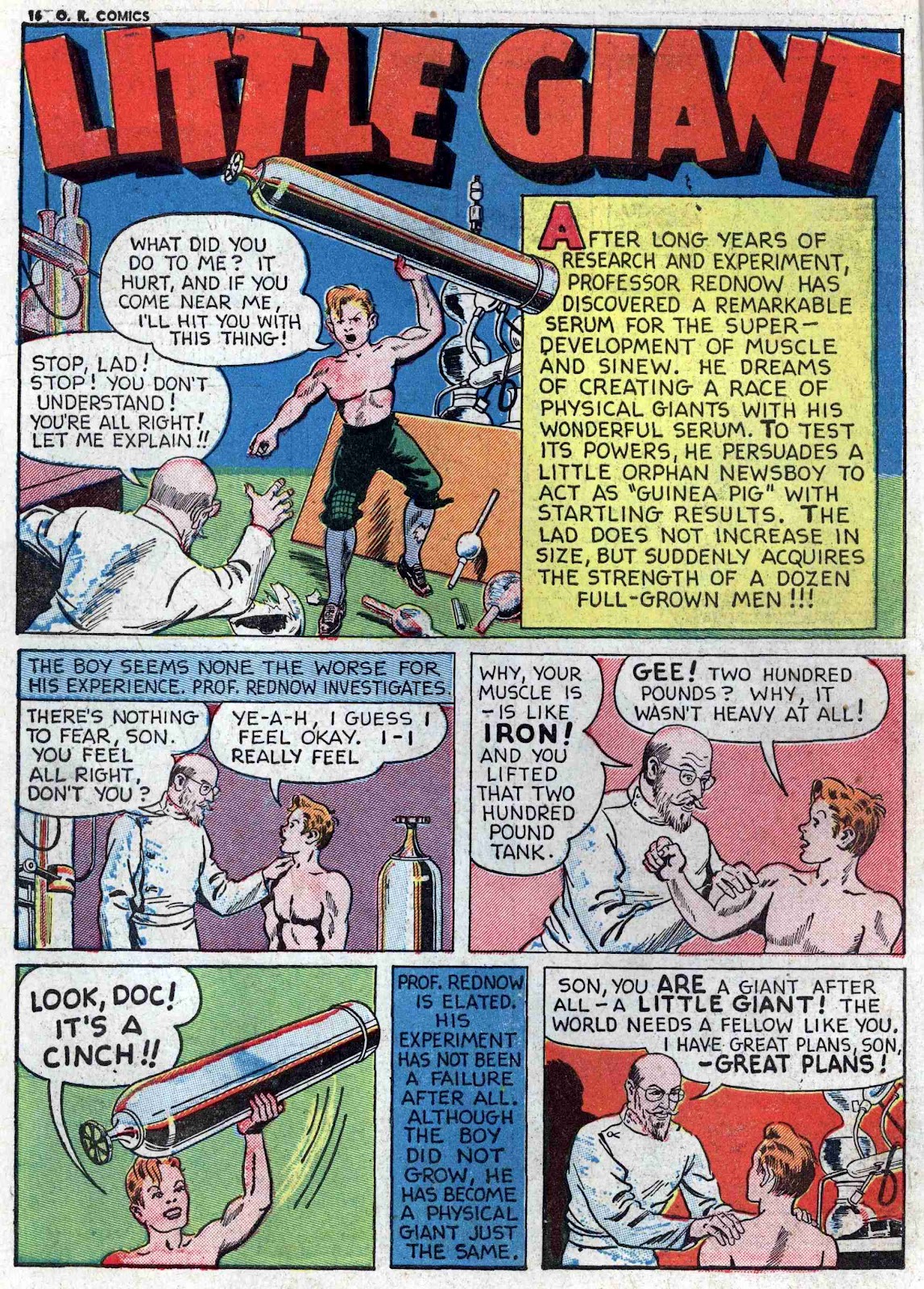
One of the rarer panelological gems in my Pantheon is the first issue of O.K. Comics, from 1940. How I found this scarce title is an adventure in itself. It was sewn into the side of a steamer trunk--along with a suicide note! I purchased the trunk in 1971 as a storage container for my then much-smaller collection of Golden Age treasures. I noticed the protrusion in the trunk's lid for years, but never felt compelled to further explore it. Finally, as I dediced to donate it to charity in 1983, I took an Ex-Ac-To knife to that bulge. Out slid this breath-takingly rare comic magazine, and a sealed envelope!

I have lost the letter in the intervening years, but it was typical of a sad person's last words... "give the enclosed to Kathy," the note ended. I assume that "the enclosed" was this scarce comic magazine. There are many Kathys in this world, and, at this late date, I do not possibly know which Kathy to give this grand publication to. "Finders, keepers," I say. Had I not "scratched that itch" of curiosity, a glorious piece of panelological history might have been forever lost.

An outstanding story in this early, obscure effort is "Little Giant," written and drawn by Mel Carruthers. I herewith present it to you now...


I must confess that elements of this story fill me with unease. I cannot quite put my finger on what bothers me about it. Suffice it to say that a certain feeling of dread sweeps over me each time I read these six pages.

The story begins "in medicas res," or, in English, "in the middle of the action." This was uncommon among early panelological story-tellers, who preferred to start their stories "a la primo," or, in English again, "at the beginning."

Perhaps it is Professor Rednow's apparent kidnapping of "Rusty," the crippled orphan newsboy. Or his presumption in spraying the lad, from head to toe, with the mystery chemical "impurvogen." Would this chemical not also cut off the boy's pores, and slowly suffocate him in what must certainly be a prolonged, painful death?

Such lack of attention to detail was a thorn in the side of Mel Carruthers, who toiled in the backwaters of the comic magazine and pulp magazine fields from the 1920s to the mid-1940s. Carruthers got his start writing for the adventure pulps. Somehow, his characters always do things the hardest way possible. An early series of lumber-camp stories, starring "Crush Peters," has its protagonist hurtling himself into the sides of trees, over and over again, sometimes taking days to fell a single oak.

Simlarly, another "pulp" series called "Speed Rogan" concerned a brash race-car driver who insisted on running behind his car and pushing it. Needless to say, he seldom won a race.

"Little Giant" was among Carruthers' more coherent storytelling efforts. He previewed this series in a 1938 feature called "Big Midget." In this short-lived series, the world's largest midget, "Stretch" Arvon, who measures an average 5'8", solved maritime mysteries with the aid of "Pepper," a talking raven. Each tale of "Big Midget" would invariably end with a group of policemen nodding their heads in wonder, and saying such things as "He's the BIGGEST MIDGET I've ever seen!"

Sadly, only one more episode of "Little Giant" appeared, as O.K. Comics folded with its second issue. That story, which I have yet to see, is evidently Carruthers' swansong to the panelological realm,

When Mel Carruthers wasn't writing improbable stories, he ran, in secret, a vast empire of early pornographic books and pamphlets. A common theme of these anonymous works is that of a scientist abducting a young man or woman and subjecting them to some sort of chemical process that alters their bodies, moods or outlooks. Apparently, this theme ran deeper in Carruthers' work than many might know or understand.

Carruthers was arrested, and his back stock of prurient publications burned to the ground, in a police raid in July, 1944. A few examples of his notorious "smut" (really, rather tame by modern standards--most of them could be made into TV movies) remains, and resides in several national archives. I have seen a copy of his 1943 novelet, Dark Graces, but its asking price of $25.00 was "too rich on my blood" when it was offered for sale in 1975.

Carruthers was jailed on federal charges of peddling pornography, and served 19 years in San Quentin. He left the prison a changed man. Now an accomplished painter in oils, Carruthers' specialty was air-borne kites. His six-panel, photo-realistic masterwork, An Ideal Day, hangs in the Smithsonian Institution, and is frequently cited as the single finest painting of a kite ever done.

He became a recluse in the 1980s. It is rumored that he is still alive, and still painting--his energies turned now to wind turbines, and his long-lived "kite phase" a thing of the past.

Before I conclude this "message in a bottle," I must satisfy reader curiosity. Yes, "super-Senior" is still in action. He has not found much in the way of crime, and is, I fear, somewhat disappointed in our sleepy little community. Many is the night that he opts to simply watch "The Bob Cummings Show," which precedes "Life of Riley" on weeknights.

It is just as well. I confess I do not enjoy being "Katto" to his "green Hornet." The life of a crime-fighter's chauffeur is seldom exciting--and often dull. I'd much rather prepare some microwave popcorn in anticipation of our nightly "TV treat."

It is unlikely that I shall "post" again until after my "father and son" "road trip." So "stay tuned" for "further developments!"

Friday, January 20, 2012

Belated But Sincere Salutations for 2012! Featuring "Zardi- The Eternal Man!" From Amazing-Man Comics 16!

Friends, comrades, amigos--'tis richly satifsying to be at the keyboard, to construct a new blog post for your edification and enjoyment!

2011 is gone--nay, these 20 days it's been dead and buried. Who knows what 2012 shall bring? Feast? Famine? Bloodshed? Peace? Only the universe knows for sure... and she seldom warns us in advance!

Little has changed here, since my last bolg posting in November. The "11" dis-assembled the week before Christmas. Apparently, the lure of clean American socks and underwear, of fresh-baked holiday dinners and doting grandparents, was enough to break up this band of scruffy protesters.

Only one remained here--a chipper but funny-smelling lad named Jeffrey, whom the Diner has hired as a dishwasher. He is industrious, and of good spirits, but there is a certain vacancy to his presence. I've tried to engage him in conversation many times, but the trail of thought peters out. Soon, in mid-sentence, Jeffrey drops the thread and returns to his dish duties. He hums and hums as he washes our plates and cutlery. I suppose he is happy! Well, more power to him if this is so. If simple suds and hot water, the clanking of china and the tingle of "eatin' irons"  is sufficient to please him, then he, i n the words of Hemran's Hermits, is "into something good."

A certain complacency has settled in with the New Year. In our biggest news item: Bradley Kolger is no longer a resident of our home. He was quietly but firmly ousted two weeks ago.As you no doubt had intuited, his presence grated on Dorrie something fierce. Truth told, he had "burned his britches" with even "Sparks" Spinkle by the end of his residency.

Mr. Kolger grew fatter and lazier with each passing day. Tell-tale signs were rampant. His lack of clothing, for example. He digressed from simple attire to boxer-shorts to, finally, a ragged beach towel, which he wore like a sarong. Bathing was a rare event in his life, as were other aspects of civilized grooming.

The "capper" was his hearing of a TV commercial which featured the "la la la" refrain of the Beatles song "Hi Jude." Mr. Kolger took to that sing-song cadence like a drunken lark. At all hours, day and night, he might belt out several choruses of just the "la la la" interval of said song.

I have described Mr. Kolger's unfortunate tendency of "banjo-humming." "Hi Jude" was subject to that rather unique--and grating--interpretation as well. That was, as they say, the needle that broke the camel's eye! Dorrie, her much-needed sleep broken by this "humming," bolted from bed and stoermd down the hall to Kolger's lair. I heard the following--for I dared not take part of the scene...

DORRIE: OK, buster!
KOLGER: (banjo-humming)--Hunh?
DORRIE: Pants.... on... NOW!
KOLGER: Do what?
DORRIE: Get. Dressed. And. Leave. This. House.
(silence)
DORRIE: Now.
KOLGER: But it's after midnight, lady...
DORRIE: Now.
KOLGER: You wouldn't throw a senior citizen out on the streets, would you?
DORRIE: (deep sigh) In the morning, then. But. No. More. Humming. Go. To. Sleep!
KOLGER: You don't have to be rude about it...
(door slams; footsteps storm towards bedroom; I feign deep sleep as "the missus" crawls under the covers)

The next morning, Mr. Kolger was driven to a local senior citizen center and signed up for free lodging there. I supoose it was the right thing to do. Mr. Kolger had proven something of a let-down. How I'd hoped that his memories would provide me with a wealth of panelological data!

Alas, his accurate remembrances were few and far between. I had the sneaking feeling he was just inventing stories to humor me. Among his more spurious claims was that artist Bill Everett was, in reality, two spinster sisters who lived in rural Minnesota! Having met Mr. Everett at a comic book convention, "back in the day," I can attest that he was neither female nor two people--just one hard-working man.

I last saw Mr. Kolger posing as Santa Claus, ringing a bell in front of a ShopWay store. It was two weeks after Christmas, but I suppose a man dressed as St. Nick can summon a coin or two from a forgetful soul here and there.

Before his ousting, Mr. Kolger did, to his credit, remind me of one of the forgotten genuises of what I call the Age Prime Panelological (1936-1942). "Steve Wardell. There was a storyteller," he said.

"I'm not aware of a Steve Wardell," I said. "Elaborate, please."

"Steve was an older guy. Looked like one of those photographs of characters from the Civil War. Had a white beard. Wore a string bow tie. Looked like a Kentucky colonel. He brought in a couple of stories while I was still in comics. He did some series about an old man who could become young again. It was great stuff."

I was sure Mr. Kolger was up to more of his spurios trickery. Later, in conference with "Sparks" Spinkle, we made the connection. "Sparks" sat bolt upright from a deep nap. "Mace! We gotta go to the Pantheon... now!"

Silently, we shoed ourselves and hopped in the Pruis. "Prince of Zanzibar," "Sparks" said, more to himself than to myself. "Something about Eternity Man..."

"Sparks" raced to the door of the New Pantheon and was clearly itching to get inside. He did the nervous dance of a man waiting in line for a restroom after several quick beers. I unlocked the door. "Sparks" made a bee-line for box D11. He lowered it to the floor and squatted beside it.

I saw a colorful flash of covers of the beloved Centaur title Amazing-Man Comics. Among my most cherished possessions is a complete run of this seminal title, which featured stunning achievements of the Age Prime Panelological.

"Sparks" skilfully leafed through issue after issue, his movements adroit, and respectful to the aging pulp paper. Finally, he cried "Ah, HA!" and stood, again bolt upright. "Maceroony, this is IT! Ol' towel-boy was right!"

We read the story you are about to experience in aweful silence. 'Tis the way I recommend that you, dear friend, absorb this masterful piece of the art panelological:


This rousing saga is dedicated to those among us who are over the age of 60. How bittersweet the concept of "Zardi" is to us in the autumn of our years! Imagine--being able to summon the vitality of lost youth with one swish of a magic cape!

Oh, to be spared the back aches, the arthritis, the eczema of advanced years! 'Tis a fantasy far more appealing than that of "Superman," "Captain Marvel" or even "Ibis the Invincible."

And, to quote my compadre, Mr. Spinkles: "Whillikers, could this guy tell a story! Wow!"

Wardell's blend of fantasy and stunning realism is stunning. For example. witness the marvelously true-to-life sequence, on page two of the tale, in which Zardi, despite the magic powers at his disposal, chooses to call directory information to secure information about a car's owner! This, from a man who can change his age, be invisible, and cast other phantasmagoric incantations! 'Tis just what I would do, were I Zardi!

Witness, as well, the poweful symbolism of the villains' attempts to turn living flesh into immovable stone! This, once again, deeply resonates with this particular senior citizen. Many mornings, I feel as though I've been tainted with Kali's treacherous brush!

"This story inspires me," "Sparks" told me, in strictest confidence, later that evening. "It's time a certain senior citizen crime-fighter went back on the job. There are evils--misjustices--all around us. Things it takes a masked avenger to repair!"

Thus, once again, I am the chaperone of  "Super-Senior," as he seraches out crime on the timid streets of our fair city. We have accosted one litterer and two loiterers. "Sparks" takes great pride in each wrong righted. I am thankful for the excellent mileage of the Prius, and that a nightly 11:30 PM rerun of "The Life of Riley" provides a strong structure to our nightly "crime patrol."

I've become quite fond of Tom D'Andrea's laconic portrayal of Riley's next-door neighbor, Gillis.

Oh--I've quite forgotten to add my own historical research to this blog posting. I cannot let this responsibility to the arts panelological lapse!

Steven Wardell was born in 1876, somewhere in the post-Civil War Southeast. There is very little data available on his life or work. His only panelological works appear in Centaur magazines, and no trace of his work is seen by 1941. He would have been my age when he wrote and drew the adventures of Zardi.

His draftsmanship suggests a bygone era. There is no sign of the sleek streamlining of younger panelologists. Wardell carefully crafted each pen-stroke, and was a stickler for detail. He owned a complete magician's outfit, including the all-important cane and cape.

A few younger cartoonists befriended Wardell, and, with his encouragement, strived to better their own work. Said Charles Quinlan, in a 1967 interview:

Wardell was a wonderful guy. He'd spend months on these six-page stories. He'd do sketch after sketch of key scenes. Any one of them would have been more than fine. But he insisted there was only one way to draw a scene right.


I still have... he gave me a couple of his sketchbooks. One is all canes! Canes drawn from every conceivable angle, over and over... the other one is all capes. Every wrinkle, fold and angle you could want on a cape is in this sketchbook. I used 'em on Cat-Man and other work I did. Wardell saved me a lot of time, and I'm glad I knew him. He taught me to put my all into every panel. 


Of course, I produced less work that way, and made less money. I used to kind of gently curse Wardell every time I cashed a pay check. But I had a conscience. I had to do things his way. It never quite left me.

One wonders what happened to those fabled sketchbooks! I imagine they would fetch a small fortune on Ebay, or some similar web sight.

Well, 'tis time to go to the Diner and prepare for a busy day. I can almost hear Jeffrey's humming as I write these words.

POST-SCRIPT: Colleagues have informed me of my apparent presence on the popular notworking site, FaceBook. Indeed, some quipster has posed as myself online! This mysterious prank-puller appears to bear me no ill will. I am not a member of FaceBook--this I can assure you. I am too busy correcting Raphael's mathematical mistakes, and prodding Katrice to bus tables, to dawdle online and tell all about my daily minutae!

Unless, or until, this charlatan attempts to libel my good name, I shall let him (or her) have their innocent fun. I've gained many new e-mail friends from this FaceBook impostor. Person or persons: consider this a polite warning! Do not misuse the name of Mason James Moray! Elsewise, you may suffer the wrath of a certain senior crimefighter. Take care--beware!


Tuesday, November 29, 2011

Holiday Highlights, Local "Occupiers" and Chemical Flea-Men! "Doctor Hormonr" from Popular Comics 58, 1940

Hale and hearty salutations to one and all! 'Tis a pleasure to be here again, sharing the joys of panelology with my internet friends and companions. Our little hamlet has been cast into the pelirous waters of modern-day politics!

I'm sure you've perused the news media and seen accounts of the various "Occupy" movements. Something about 99 per cent of something, and I believe they're after the missing 1 per cent. Seems like something from an old Republic Pictures "chapter play" to me. But I assume there are bigger stakes at hand.

Believe it or not, we have had our own "Occupy" movement here! True, it consists of 11 bedraggled, unbathed young men and women. They have pitched five tents on the lawn of Mayor Miggins--who, I suspect, has had not a moment of peace since this gaggle of scruffy children "occupied" his prime Kentucky blue grass! (He has it imported from that fair state, via squares of sod and grass, each August.)

We are far, far away from Wall Street and its high-stress concerns here, but the hand of political actisivm is felt nonetheless. These 11 "occupiers" have made Dorrie's Diner a sort of second home. My goodness, how these "young folk" can talk--lecture, more accurately. And how they can eat!

All of them seem named after something found outdoors--Leaf, Loam, Shallot and Cloud are four names I've learned. Gone, I suppose, are the days of Harry, Sheldon and Frank! But, then again, this i s the 21st century we live in--not the past!

You might not think me a political thinker. 'Tis true, my thoughts run more to the halcyon pages of my beloved comic magazines of yore. But I keep my finger on the pluse of the new events. This trend goes back to my teen days. You've heard me speak of the musical duo of Mason and Rusty here. True, our repertoire did lean heavily on that of our idols, Peter and Gordon, but we did include a couple of "messager" songs, as those were popular with our peers. I still recall our Peter and Gordon-styled version of "Masters of War." We did it with a softer, bossa nova style of rhythm. Arranged for two voices in harmony, it always went over well.

We, of course, also sang "Eve of Destruction." I never could get all the words sussed out on that one. Some thing about bodies floating--it still puzzles me, when the original tune plays on my "oldies" radio station. We just mumbled through that part, but it, too, cheered our classmates.

Back to the present, friends. I'm somewhat impressed that the fire of politics still finds root in the hearts of the young. But I recall that I, at this age, bathed, shaved and changed clothes with far greater frequency. I have attempted to pass on these pearls of wisdom to our "Occupy 11," as they drift in and out of the Diner (which is parallel to their "tent city" on Mayor Miggins' front lawn).

Alas, the good mayor has temporarily abstained from his twice-a-week visits to our little eatery. Whenever he shows his head outside his home, much like the groundhog on his day, he is assaulted with shouts, grunts and the expert heavings of small moist things. I pity Mr. Miggins--he is a just, fair, good-natured fellow, and I have always experienced him as being the champion of "the under guy."

Yet, ironically, these youthful crusaders of justice won't given an established "do-gooder" the chance to speak his piece. Truth told, we shall all be glad when this "occupation" is over, and these young lions find something else with which to "occupy" their spare time!

The "11," as the local newspaper has dubbed them, are inordinately fond of the ever-popular "Sloppy Doe" sandwich. Dorrie and I decided to offer a "Protester's Special." Anyone presently living in a tent, within our fair city limits, is entitled to one of these massive, fragrant, dripping sandwiches for one dollar.

As said, these hungry youth tend ot "occupy" the Diner, guitars and notebooks in tow. I've impressed them with my special arrangement of "Masters of War," sung occapella to their slack-jawed surprise. Few of them sing! They mostly huddle in a grubby group, while one lazily strums assorted chords over and over again.

Thanksgiving was a clandestine affair this year--held in secret at the Diner. Truth told, there were two versions of the meal. The one at the Diner featured a streamlined but pleasing spread, including Dorrie's knockout "Fruity Cola Bird" and her "Megaplex Pudding Cake," which features six flavors of pudding, encased in six complementary flavors of fluffy cake.

Prior to this meal, we had a sham dinner at home. It consisted of turkey bologna, bread, American cheese, and a small tray of crackers. This was for the benefit of a certain certain Golden Age cartoonist (initials B.K.).  Dorrie has made clear her abiding dislike of Brad Kolger, and has told him that he has worn out his welcome. He is advised to get into his motor home and find another place of residence.

This has caused a rift between Dorrie and myself. To be honest, Mr. Kolger has not proved the fountain of panelological wisdom "Sparks" and I might have hoped for. Some of his anecdotes seem a mite suspicious to me! You know well what a stickler I am for accuarcy. Facts, proven and measured, interest me. Mr. Kolger's imagination is evidently still keen, but our food bills have sky-rocketed. Due to his chronic weight gains, we've even had to purchase new pants for him. Otherwise, he wanders about in soiled boxer shorts and a bathrobe, 24-7.

'Twas while trying to verify one of Mr. Kolger's wilder claims that I came across the name of Bob Bugg. No, he isn't a "funny animal" character! Mr. Bugg was an overlooked, uniquely inspired creator of the Golden Panelological Era. I'd all but forgotten his work until a comment by Mr. Kolger sparked my memory.

I couldn't recall the magazine in which Mr. Bugg's work appeared. I thought it to be one of the Fox titles, or a Nedor publication. An exhaustive search of my holdings from these imprints revealed nothing--although "Sparks" and I did spend several happy hours reading from these vintage issues. Let the protests of man wail and moan. Let controversy cry out. None of these can dim the brilliant, shimmering light of the "people's art" of panelology!

Finally, in an act of desperation, I rifled through a box of minor Dell Comics titles. 'Twas then that this issue of Poplar Comics literally leaped out at me. Its protective bag had an air pocket in it that caused it to shoot out of a stack and land, face-up, on my lap. Immediately, I espied the name of Mr. Bugg's magnum opus:  DR. HORMONE!

I've some interesting background material on the strip and its creator. But first, please prepare yourself emotionally for a sutnning burst of panelological art!!


What whimsy and imagination combine to produce the exotic, exciting exploits of "Dr. Hormone!" This tale is highly prophetic of the World War to come. It was created in the autumn of 1940, as the shadows of desctruction loomed large over Europe. "Bob Bugg," in reality a gifted creator named Herschel Roach, saw the war coming to the United States--a full year before the dreaded attack on Pearl Harbor!

Roach's time in the panelological field was short but sweet. His career began with a bang--his car collided with that of editor Oskar Lebeck in a Manhattan parking lot, one day in 1939. Roach had just--unsuccessfully--attempted to find work with the Harry Chesler studio. Down to his last two dollars, Roach was despondent, and failed to look in his rear-view mirror. Bang! He smashed editor Lebeck's rear fender.

The impact of the accident unsecured Roach's portfolio. Sample comic-book pages spilled all over the interior of his car. An angry Lebeck, having surveyed the damage done, saw these pages and immediately forgot his fury. For he was in need of his own "Superman"--at any cost!

Lebeck's concern oversaw a series of comic magazines that were old news in 1939. They existed before the arrival of the paenlological super-hero, and consisted of reprintings from popular newspaper comic strips. These had sold extraordinarily well throughout the middle to late 1930s, but with the arrival of a circus of costumed men of might, the fickle buying public turned away from Lebeck's offerings. He had to act--and fast!

Lebeck offered Roach a job on the spot. He put him to work, in that pay parking lot, on the creation of a new, vibrant super-character. Roach's favorite novel was H. G. Wells' The Island of Dr. Moreau. He'd long had a notion that a good guy version of the feared Moreau might prove a comic-strip sensation.

The possibilities were many: via scientific genius, and a series of experimental injections, his Hormone could change man to beast, insect or bird--and back again. It hadn't been done in comics until then. Roach knew he was onto a "sure thing."

Overnight, Roach created a dozen potential features for Lebeck's perusal. He was less enthusiastic about his other ideas. He clearly wanted "Dr. Hormone" to lead the pack--and it did!

Lebeck was intrigued by the idea of a scientific genius who was sane, instead of mad, and who helped America, rather than harm it. Dell's other super-hero entries, such as "Phantasmo," "The Owl" and "Marvel Man," had failed to "grab" the comic book-buying audience as Lebeck had dearly wished.

Roach wrote and drew "Dr. Hormone" with his heart on his sleeve, and his ear on the pulse of current world events. As said earlier, he could see, all too well, the imminent specter of war on our peaceful American landscape. Only by preparing America's impressionable youth for the onset of chaos and destruction could we be ready to face this hitherto-unseen foe, he believed.

The feature debuted with issue 54 of opular Comics, and ran for the next several issues. Alas, Roach was too much the prophet, and his message was too strong for young minds to take. The feature expired many months before America's entry into the Second World War.

Unsurprisingly, Roach volunteered for the military before "the day that will live in infamy." Alas, he was, by then, a chronic sufferer of hiccups. The attacks would come late at night, and force him away from the drawing board. He tried every "folk remedy" in the book, but the accursed hiccups plagued him without cease. (He later discovered they were due to an allergy to dijon mustard, which he consumed voraciously.)

Because of Roach's medical problem, he was deemed unsuited for military service. He continued in comics, penning features as diverse as "Ellery Queen" and "Rocky Hall, Jungle Stalker." One late feature, "The Safety Hasp," chronicled the doings of a super-powered night watchman who "made the rounds" of the criminal underworld.

"The Safety Hasp" was accepted by Everett Arnold, publisher of Quality Comics, to begin publication in his Crack Comics title in early 1943. 'Twas then that tragedy struck a panelological genius. By this time, he had learned of his mustard allergy, and that it was the source of his frequent hiccup attacks. Roach craved the spicy condiment, knowing full well of its hazards to his health.

One warm spring evening, having consumed three "red hots" slathered with dijon mustard, Roach descended into the subway, to take a train home. As a packed rail car approached, Roach suffered a violent attack of the hiccups. He lost his balance, and fell in front of the speeding subway car. A potential genius of the comic arts was lost to us that sad day in 1943.

In this, the finest of Roach's "Hormone" tales, he applies his character's genius to the unlikely form of the common household pest, the flea. Roach was a champion of insect rights, and felt that fleas, spiders and even his namesake deserved fair treatment in this "land of opportunity."

Were Herschel Roach still alive, I imagine he'd be out there, living in a tent, occupying America with his political fervor. As a tribute to these unbathed, inarticulate youth crusaders, I dedicate this "Dr. Hormone" saga.

Well, 'tis time to "feed the occupiers," so end this post I must. I trust your Thanksgiving was peaceful and pleasant. May this holiday season shower you with warmth and kindness!